Why Juliano Lissoni Believes Better Events Start With Better Questions

Skift Take
Plenty of people talk about data in events. Fewer pair it with the human context that explains what dashboards can't.

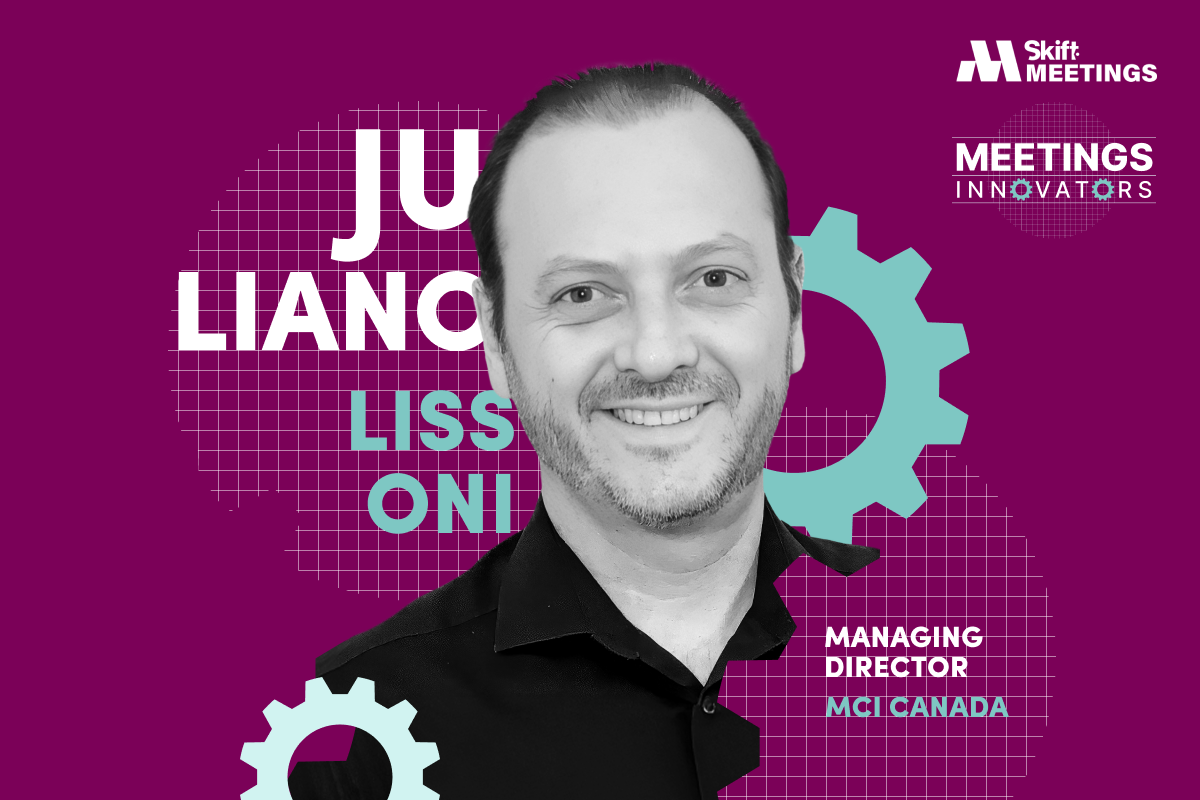
For Juliano Lissoni, managing director at MCI Canada, the events industry's biggest gap isn't creativity or execution, it's evidence. Too many events, he argues, are still built on assumption. Previous year’s formats get repeated by default without anyone asking whether they still create value for the people in the room.
As the founder of MCI’s Data + AI Lab, Lissoni has made moving "from assumption to evidence," the through-line of his work. That means treating an event not as a production to be staged but as a system designed to serve audiences, sponsors, speakers, and partners, each with shifting needs that only data can help surface. He pairs structured signals such as registration patterns, session choices, engagement metrics, with the messier human cues including open feedback and community conversation, and then designs around what those two things reveal together.
Drawing on influences from Pixar's Ed Catmull to Clayton Christensen's "Jobs to be Done" theory, Lissoni frames innovation less as novelty than as purposeful improvement. That includes better questions, a learning mindset, and the discipline to keep iterating.
What does innovation mean to you?
Innovation starts with understanding what problem we are trying to fix or what opportunity we are trying to tackle. It is not just about using the newest technology or creating something that looks impressive. It is about looking closely at the attendee experience, the business goals, the partner expectations, and the emotional journey, then asking: What could be better? What is missing? What is creating friction? Where is there an opportunity to create more value?
A truly innovative event solves a real need or unlocks a new possibility. Sometimes that means using technology, but sometimes it means simplifying a process, changing the format, making the experience more human, or designing moments that feel more intentional and memorable.
Innovation is about purposeful improvement. It is the ability to challenge the default way of doing things and create an experience that is more relevant, more engaging, and more meaningful for everyone involved.
Why is innovation important?
Innovation is important in the events industry because events are not just experiences; they are systems designed to create value. They bring together audiences, brands, communities, sponsors, content, operations, and technology, and each of those stakeholders has changing needs and expectations. Innovation allows us to question whether the current model is still creating the right value, for the right people, in the right way.
It is what I call moving from assumption to evidence. Instead of repeating a format because it worked before, we should be asking: What outcome are we trying to achieve? What behavior are we trying to influence? What problem are we solving? What data tells us the experience is working? That mindset helps transform events from one-time productions into platforms for engagement, learning, relationship-building, and measurable impact.
The events industry needs innovation because audience attention is harder to earn, budgets are under more pressure, and stakeholders expect clearer returns. Attendees want relevance and personalization. Sponsors want meaningful engagement, not just visibility. Organizations want experiences that support broader business goals. Ultimately, innovation matters because the industry cannot rely only on creativity or execution. Those are essential, but the future of events also depends on strategy, experimentation, data, and continuous learning.
What areas of events need innovation the most?
I think the biggest opportunities are audience understanding, the attendee journey, personalization, accessibility, sustainability, sponsorship value, and measurement. Too many events are still designed based on assumptions, legacy formats, or what has worked in the past. Today, we have a much greater capability to analyze both structured data, such as registration patterns, attendance, session choices, engagement metrics, and survey results, and unstructured data, such as open feedback, social media conversations, community discussions, chat interactions, and qualitative insights. That gives us a much richer understanding of audiences and stakeholders.
For me, this is where events need to evolve the most: from being primarily production-driven to becoming more insight-driven. The experience should be designed around what we know about people’s needs, behaviors, motivations, and pain points. That applies not only to attendees, but also to sponsors, speakers, partners, exhibitors, and internal stakeholders.
Measurement is another area that needs major innovation. We need to move beyond basic satisfaction scores and attendance numbers. The industry needs better ways to measure engagement, learning, relationship-building, business outcomes, sponsor impact, and long-term value.
I believe the biggest innovation opportunity is using data and human insight together. Data can show us patterns, but human-centered design helps us interpret those patterns and turn them into better experiences.
Who has inspired you in your innovation journey?
There are two people who have deeply inspired me: Ed Catmull and William Kamkwamba, each in a very different way.
Ed Catmull, co-founder of Pixar, has inspired me for a long time because of the way he connects creativity, leadership, culture, and innovation. I recently had the pleasure of spending time with him, which made that admiration even more personal. What I admire most is his belief that innovation is not just about great ideas, but about creating the conditions where ideas can be challenged, improved, and brought to life.
William Kamkwamba (The Boy Who Harnessed the Wind) inspires me from another perspective: resourcefulness. His story is a powerful reminder that innovation often starts with a real problem, limited resources, and the courage to imagine a different solution. He represents the idea that innovation is not only about having access to the best tools, but about curiosity, resilience, and the ability to create possibility from constraints.
When you look to innovate, are there concepts that you regularly return to for inspiration?
I tend to come back to a few ideas that have shaped the way I think about innovation.
From Ed Catmull, I take the idea that innovation needs the right culture around it. It is not enough to have creative ideas; you need an environment where people feel comfortable being honest, challenging each other, surfacing problems early, and making the work better together. That is very relevant in events, because the best ideas usually become stronger through collaboration and iteration.
From Clayton Christensen (late Harvard Business School professor), I often think about the “job to be done.” In events, that means asking what people really need from the experience. Are they coming to learn, connect, be inspired, build relationships, solve a business challenge, or feel part of a community? When you understand that deeper need, you can design something much more meaningful than just a good agenda or a beautiful production.
And from Hal Gregersen (MIT Sloan), I always come back to the power of questions. I really believe that better questions lead to better innovation. Questions like: What problem are we really solving? What assumptions are we making? What are attendees or stakeholders experiencing that we are not seeing? What would we do differently if we were starting from scratch?
How do you get buy-in for your ideas?
I get buy-in by connecting the idea to a clear purpose. Innovation cannot feel like change for the sake of change. People need to understand why it matters, what problem it solves, and what value it creates. I try to bring people into the process early, listen to concerns, show examples, and start with practical steps. When people can see the benefit and feel included in the direction, they are much more likely to support the idea.
What’s the role of failure in innovation?
I think failure is directly connected to two key skills every innovator needs: curiosity and a learning mindset.
Curiosity is what pushes you to ask, “What if?” “Why not?” “What could be better?” It gives you the energy to challenge assumptions and explore new possibilities. But curiosity alone is not enough. You also need a learning mindset, because not every idea will work the first time, especially in events, where there are so many moving parts, stakeholders, and real-time variables.
A learning mindset means having the courage to try, the humility to recognize when something did not work, and the discipline to adjust and improve. It also means having the guts to experiment and accept that failure may be part of the path to something better.
So I do not see failure as the opposite of innovation. I see it as part of the innovation process. The real failure is not trying, not learning, or repeating the same mistake without reflection. Innovation requires openness, resilience, and the willingness to keep improving.
What’s your advice for aspiring innovators?
Stay curious, ask better questions, and stay close to the people you are designing for. Innovation should not start with the desire to look different; it should start with a real problem to solve or an opportunity to create more value.
Understand the real job to be done. What do people need? What friction are they experiencing? What are they not saying out loud? Use data, observation, and empathy together to find those insights.
And then, have the courage to test and learn. Not every idea will work the first time, but a learning mindset helps you adjust and improve. Ideas matter, but execution is what creates impact. Start small, prove value, bring people with you, and keep building.