How Events Are Coping With Geopolitical Crosscurrents

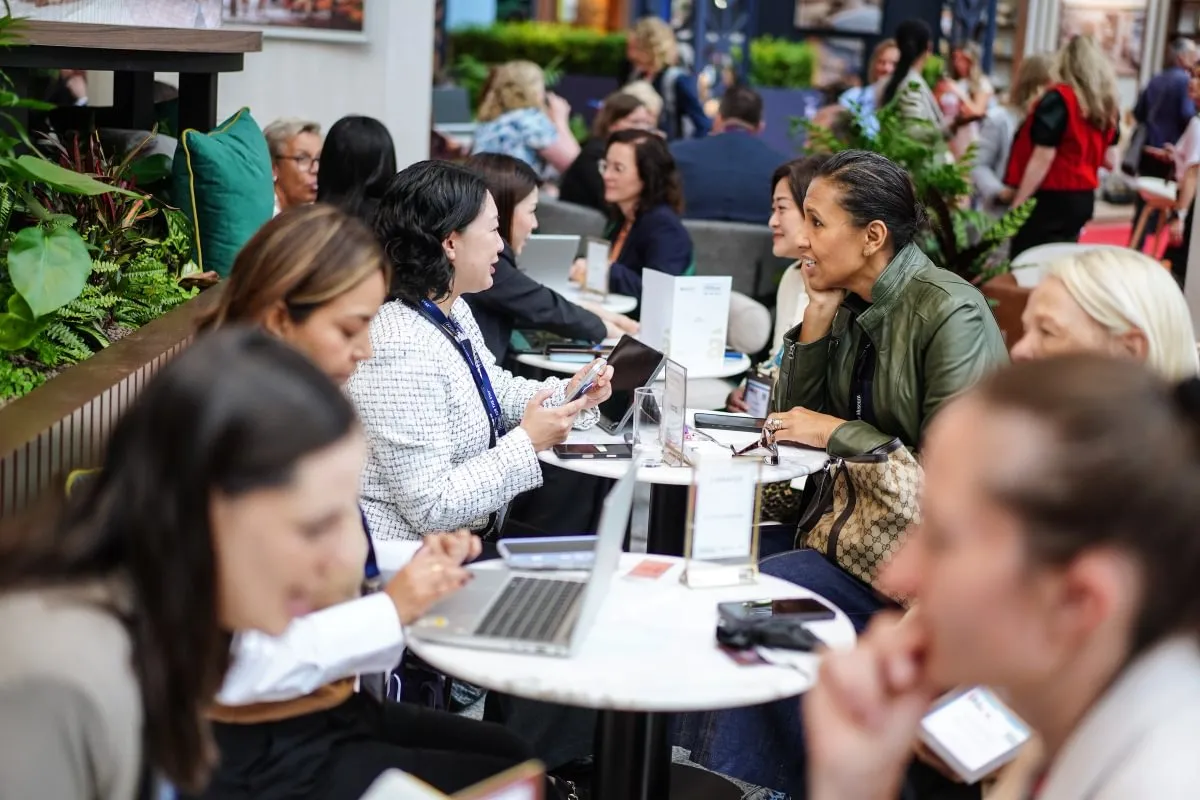
Photo Credit: IMEX
Skift Take
From public announcements to quiet corridor conversations, IMEX Frankfurt 2026 revealed the complex impact of geopolitics on global events.

The latest edition of IMEX's European show, offered participants a glimpse of the state of the global events industry. Compared to last year, the geopolitical uncertainty was more obvious, no more resolved but somehow the events world appears to have gotten used to this level of stress.
IMEX Frankfurt is a truly global show — much more so than its larger U.S. counterpart — offering a mainly European perspective of the world. Walking up and down the aisles means crossing continents and interacting with a diverse set of people with different backgrounds and ideologies. All these people are finding ways to work together regardless of how geopolitics is reshaping the direction of business. From Middle Eastern destinations that made sure to be present and engaged, to African destinations looking to join in the same game.
The events world is not thriving, but not panicking either. As a whole, events are shifting, adapting, and creating ways to navigate political stances that shift where people can, want, and feel safe gathering.
Middle East on Pause
Prior to the show, there were big questions about how destinations like Dubai, Abu Dhabi, Qatar, Oman, and Ras Al Khaimah would manage their IMEX presence. The reality was very much business as usual, with a large booth where partners held plenty of meetings and private conversations. The key message: we're ready, flexible, and waiting patiently to welcome the rest of the world back.
"The ability to absorb shocks and maintain business continuity and gaining confidence. This is something that we are doing, and we don't take that for granted," said H.E. Juma Mohammed Al Kait, advisor to the United Arab Emirates Minister of Economy and Tourism, speaking at a state of the industry session led by jwc partner Kai Hattendorf.
Middle East destinations are confident that the moment is temporary and they invested in their presence at IMEX, maintaining relationships, and signaling that when the geopolitical moment shifts, they'll be open and flexible. "We don't close. Yes, there is an issue, but things are moving towards recovery at some point," Al Kait said.
The reality is it’s business as usual in the region with regional events going ahead, but the Iran war and broader regional instability have made international business travel to the region difficult. Major international conferences have been postponed or disrupted, but importantly, most were not cancelled, at least until now. It's clear the Gulf destinations are doing everything they can to keep that cancellation away from the minds of organizers.
In the background, and without applying any pressure, Europe is picking up the pieces. Some organizers with large events confirmed for the Middle East in 2026 and 2027 have opted to move their events to European destinations, with many swapping dates to keep the return to the Gulf in their planning. Among these are the 2026 World Congress on Ultrasound in Obstetrics and Gynecology, which moved from Dubai to London, the 2027 Rotary Convention that swapped Dubai for Barcelona, and the 2027 World Congress of Nephrology that shifted from Dubai to Kuala Lumpur.
The Trump Effect Continues
The unknown impact of President Trump’s second term on the events industry was the big topic at last year’s IMEX Frankfurt, and it continued this year with more clarity over the actual tangible impacts. U.S. Travel Association's Managing Director, Group Travel Kevin Hinton was at the show to offer a reality check, recognizing the negative impact on U.S. inbound travel but dispelling doom scenarios.
The Academy of Management moved its 2027 annual conference out of the U.S., and won’t be holding its flagship event there through at least 2031, with three out of four of the next meetings taking place in Europe and the other in Canada. That's one data point. But the corridor conversations at IMEX suggest it's part of a broader reassessment happening across the association world, with Canada the main beneficiary.
Anecdotal conversations revealed a positive flow of inbound inquiries from U.S.-based associations with international remits, seeing Canada in a new light. The logic is straightforward. Canadian cities still pull U.S.-based attendees and sponsors. But they also attract international delegates from Europe and other regions who are reluctant to travel to the U.S. right now. Data seems to back this up, with the latest datapoint coming from the Simpleview Sales Quarterly 2026 Q1 report, which points to a positive trend for Canada’s convention center bookings and room nights, bucking a negative trend for the U.S.
Europe may also be benefiting here, with some conversations suggesting sponsor funds and attendees opting to support European-based associations rather than U.S.-based ones for specific verticals.
The Brand USA presence at IMEX Frankfurt told its own story. Major U.S. destinations — Las Vegas, New York, San Francisco — each had their own booths, grouped adjacent to a Brand USA country pavilion that gives the U.S. presence a sense of unity it hasn't always had.
Destination DC offered perhaps the most candid window into what U.S. destinations are navigating right now. At an exclusive thinking salon hosted by the organization during IMEX, a small group of media and senior industry executives were asked for input on the destination's new marketing positioning: Meetings Capitalized. Washington D.C. is diverse, culturally rich, and deeply connected to the international community. It is also the center of a political moment that is making some of that community hesitant. Planners are focused first on the basic viability of holding events at all, and for a capital city, that scrutiny cuts deep. To their credit, Destination DC is not waiting for the moment to pass. They're seeking external perspectives, particularly from Europe, on how to maintain and strengthen their international brand. Even though 90% of their convention business is domestic sources, and in some ways, they don't need to do this. They're doing it anyway.
Zooming Out for a Global Perspective
At PCMA Convening Leaders in January, Zanny Minton Beddoes, editor-in-chief of The Economist, laid out geopolitical uncertainty, a faltering economy, and AI as the three global revolutions of our time. She also identified Europe as the least dynamic economic region and most likely to get left behind. For the moment in the world of events, this is playing out quite differently. Europe and Canada are the unexpected beneficiaries of a moment they didn't engineer. Neither region is aggressively marketing itself as an alternative to the U.S. or the Middle East, but both are seeing benefits, which may be more or less temporary. They’re perceived as stable, welcoming, and politically aligned with much of the international community that is making event decisions right now.
China's direct footprint in the global events industry has been quieter since the Covid pandemic. But its geopolitical influence — particularly across its immense African infrastructure investment and political relationships — also plays a part in the puzzle of international events. The recent last-minute cancellation of RightsCon in Zambia, allegedly the result of Chinese pressure to block access of a Taiwanese delegation, is a striking example of what the indirect consequences of geopolitical uncertainty look like in practice.
IMEX also brought a visible push from destinations that don't yet command attention on the international circuit. Angola launched its convention bureau, and Mozambique is set to follow, both having a presence at IMEX for the first time. Angola has infrastructure backing its pitch — a new airport and a convention center on the way. Mozambique is earlier in its journey, but present and visible.
Ajman, one of the lesser-known Emirates, showed up for a second year with a stand that outpunched its profile, operating in the shadow of Dubai and Abu Dhabi but clearly playing a longer game. Uzbekistan was another lesser-known destination with an oversized presence.
None of these destinations are benefiting directly from the current geopolitical disruption. But they're all making their case and feel confident that they want to play a part in the future of global events.
Destinations want to be part of the global events industry’s $1.3 trillion economy, the key figure in the Events Industry Council's 2026 Economic Significance Study. Data about the size and scope of the industry was constantly surfaced in destination pitches at IMEX, and also at the Place Leaders Forum, the successor to the IMEX Policy Forum and IMEX Politicians Forum. With the industry found to be supporting 24.2 million jobs and contributing $3.1 trillion in total business sales to the global economy, it is no surprise that destinations continue to spend significant budgets to be at shows like IMEX, even despite the unpredictable impacts of geopolitical instability. And while the industry has no power over global politics, it appears to be working out ways to adapt and move forward.