Event Leaders Share How the Iran War Is Impacting Global Events


Photo Credit: Unsplash / Emin Huric
Skift Take
The effects of the Iran war are spreading beyond the immediate region, compounded by rising costs and attendee fears of travel.

On March 9, Mohamed Mezghani, secretary general of UITP (Union Internationale des Transports Publics), was forced to make one of the hardest decisions of his career — to cancel the 2026 UITP Summit, which was scheduled to take place in Dubai April 21–23. Unlike regional events like ATM and LEAP that have been postponed to later in the year, his event, which was expecting 8,000 attendees, will no longer take place.
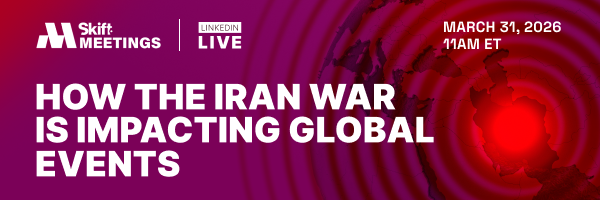
During Skift Meetings’ LinkedIn Live on April 10, moderated by Editor-in-Chief Miguel Neves and Executive Editor Andrea Doyle, he described the decision to cancel the 8,000-attendee summit as “heartbreaking.”
His fellow panelist, Nicola Kastner, CEO of ELX, has been dealing with the crisis from a different perspective, as the leader of a community of senior event leaders. Kastner has shared her concerns on social media posts and has held two emergency meetings of ELX members in the past month.
Uncertainty is Worse Than Canceling
The decision to cancel the UITP summit just weeks before it was set to take place was based on mounting uncertainty, logistical constraints, and pressure from stakeholders needing clarity. The logistics were enormous, including bringing in buses for the exhibition.
Mezghani explained how UITP’s choice to cancel altogether was influenced not only by cost scenarios but by the need to support its members and maintain credibility. Postponing was not an option, because several other competing events were scheduled later in the year. A further argument against postponing was that cancelling after postponing would incur an even larger financial loss.
“In addition to our exhibitors and attendees — who are our members, and have been for decades — we also had a destination host that we were trying to be empathetic toward. It wasn’t a business-only decision,” Mezghani said.
A key takeaway, he said, is that the uncertainty can be as disruptive as the conflict. Exhibitors and attendees often prefer a decisive cancellation over prolonged ambiguity, especially when significant costs — such as shipping materials and booking travel — are involved.
Transparency and Perceptions
Kastner said that more than 25% of the ELX community showed up for each of her two emergency calls. During the first call, members expressed concern about the people that were in the region, while on the second they focused on how they were forecasting and budgeting.
She has been hearing from members who have postponed their events to the fall. “That creates an awful lot of compression in the market in the fall if those events are able to go ahead.”
Whatever the decision, it’s important that event leaders be clear and transparent. “It takes me back to the Covid days, when event teams were the first to see inside their organizations,” she said. “We sit between risk, duty of care, business impact, operations, and travel. During Covid times — and again now — event teams need to lead the conversations.”
Kastner also reported that there is some sense of business as usual in parts of the Middle East region, pointing to an ELX colleague who just traveled to Oman for an exhibitor training session. “Not only was it not canceled, but they had double the amount of attendees than the organizers had anticipated. And this was for big trade shows that are taking place in May.”
It’s important to view the conflict from more than just a North American perspective, she said — and to not make sweeping judgments. Event organizers must manage not just actual risk but perceived risk, and perceptions vary globally. While Western attendees may hesitate to travel to certain regions, participants from regions such as Asia, Africa, or Latin America may be more willing to.
The alternate destinations planners are choosing depend on the specifics around the event, the objectives, and the attendees. Europe is seen as a safer choice for U.S. incentives, which are also relocating domestically and to the Caribbean.
It’s important to realize that risk is a moving target, said Kastner. “Did we think six months ago we'd be talking about a war in the Middle East specifically impacting Dubai? I wouldn’t have hazarded a guess. That’s why it’s important for planners to be aware, be prepared, and work closely with their risk and security teams.”
Rising Costs, Again
Rising fuel prices since the war started (up to 64% for aviation fuel) are increasing travel and logistics costs globally. For attendee travel and everything surrounding an event — freight, staging, and catering — costs are going up.
This is on top of costs that had already been rising.
“Everything's gone up and now this just compounds it. So it's increased costs on top of something that's already increased” said Kastner.
As a result, event budgets are under pressure, with planners now forecasting 15–25% higher travel costs and potentially more across other categories.
_________
View the LinkedIn Live here.