Freeman Launches 3D Visualization Platform

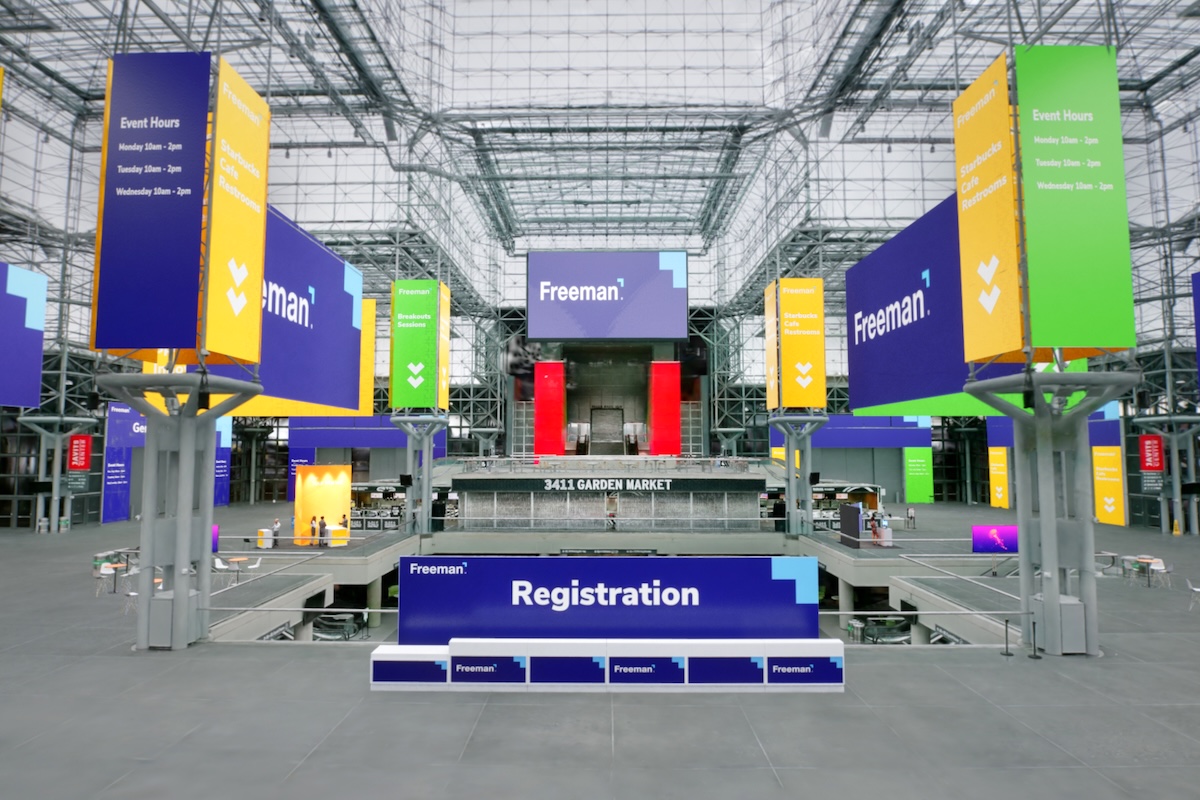
Photo Credit: Freeman
Skift Take
Freeman's new in-house platform turns convention center floor plans into navigable 3D environments — and has the potential to change how planners visualize, sell, and build events before a single booth goes up.

Freeman has launched Freeman Blue Echo, a platform that creates interactive 3D models of venues, allowing planners, designers, and clients to visualize events before they are built.
It combines spatial capture, AI processing, and proprietary workflows to create navigable digital environments. Within those environments, Freeman teams can layer event elements, such as booths, signage, and registration areas, to simulate how the event will function.
“That allows us to generate immersive walkthroughs and fly-through videos that reflect what the space actually looks and feels like,” said Kedar Deshpande, vice president of innovation at Freeman. “What’s important isn’t just the visuals — it’s that these environments are usable for planning. Teams can explore the space, test layouts, and make decisions earlier with much greater confidence.”
New Event Visualization Options
Deshpande highlighted how the platform addresses inefficiencies in traditional event planning, where teams rely on floor plans, renderings, and multiple rounds of revisions. “This allows us to have visual conversations first,” Deshpande said. “Clients can see what’s possible in the space, give feedback in real time, and iterate during the same session.”
Users can move through a digital venue to test sightlines, attendee flow, and placement of key assets. Planners can evaluate the visibility of sponsorship placements, assess traffic patterns, and refine layouts before committing to build.
The system also integrates operational data, including rigging points, electrical access, and wayfinding.
AI is used to process and reconstruct captured environments into interactive models and to surface relevant data for different users. For example, operational teams can access infrastructure details while designers focus on layout and branding.
Freeman started by scanning approximately 20 of the convention centers where it does the most business, a number that has already expanded to 25, including McCormick Place in Chicago, the Las Vegas Convention Center, and the Moscone Center in San Francisco.
The company plans to continue scanning additional venues, including ballrooms and meeting spaces. Updates can be made quickly. If a venue undergoes renovations, specific areas can be rescanned and updated in about a day.
In-House Innovation
The platform was developed internally rather than through acquisition or white-labeling. “We’re not relying on a single off-the-shelf AI platform,” Deshpande said. “This is a combination of emerging techniques and Freeman-built workflows designed specifically for how events are planned and delivered.”
Freeman does not plan to license the platform externally. Instead, it will be used to support its own clients. Planners working with Freeman will receive outputs, such as videos and visual assets, as part of their engagement, at no additional fee.
The company sees the platform as part of a broader shift in how events are designed and sold.
Deshpande compared the approach to film production, where ideas are visualized and refined collaboratively before execution.
“We’re moving toward a world where clients can see and interact with their event before it exists,” he said. “That changes how decisions are made.”
Freeman also expects the platform to reduce the need for repeated site visits and improve communication across teams, contributing to both efficiency and sustainability goals.