
Exhibition Industry Re-Evaluates Global Markets With Multidimensional Framework


Photo Credit: Unsplash / Thomas Lohmann
Skift Take
Germany's long history of trade shows just got beat by France, and India's crashing the party with less than 7 million square feet. Tradition and venue size alone won’t cut it, and a new ranking framework shows why.

Exhibitions consultancy jwc has released a country ranking of the top 10 exhibition markets in 2025. The company said the ranking illustrates why "market size along no longer determines competitive strength."
The release is part of the company’s annual Global Industry Performance Review 2025 (GIPR), a proprietary 900-page research report it sells for $8,593 (€7,350). Aimed at organizers, the report is equally valid for destinations looking to make infrastructure investments and establish partnerships.
This is the first year jwc has included a country-level ranking in the report, and it has now publicly released an overall top 10, along with three other segmented rankings.
Global Exhibition Market Ranking
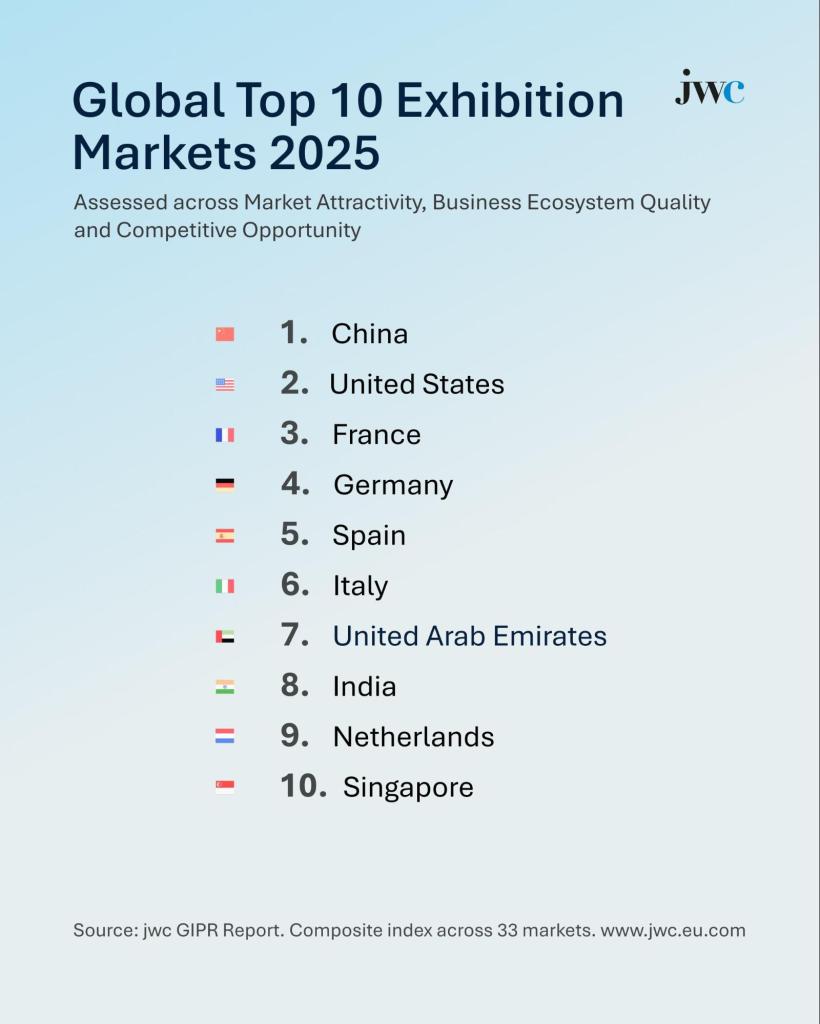
The top 10 countries in the overall ranking won’t surprise industry analysts, but France’s third place, above Germany in fourth, stands out.
Germany’s long history of trade shows organized by its larger venues has gone hand-in-hand with its industrial strategy. However, in recent years, lower occupancy of large publicly-owned venues dependent on a shrinking calendar of venue-owned shows has taken its toll. Messe Munchen's joint venture with Racoon Media Group illustrates the challenge. They will relocate the homegrown sporting goods and outdoor show ISPO from Munich to the Rai Amsterdam in the Netherlands, an unthinkable move just a few years back, now justified as progress, “agile and streamlined — better equipped to respond to evolving market demands.”
Another country that stands out in the overall ranking is India. It takes eighth place, despite offering limited venue infrastructure — just under 7 million square feet across 19 venues, according to UFI’s World Map of Exhibition Venues 2025.
“Markets can be highly attractive for very different reasons. Some benefit from sheer scale, others from competitive openness or ecosystem maturity. A multidimensional approach makes those trade-offs visible rather than averaging them away,” said Jochen Witt, executive chairman at jwc.
jwc said the diversity of market profiles makes single-metric comparisons increasingly inadequate, and its new framework enables a more nuanced comparison of markets with very different development paths.
Segmented Rankings
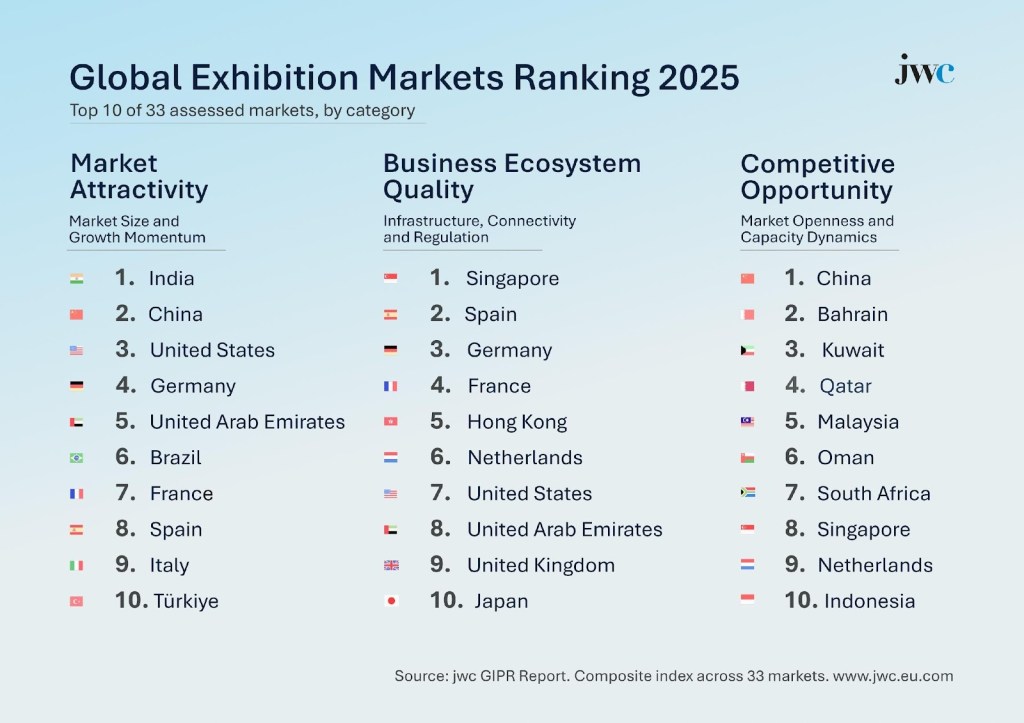
Once you look at the segmented rankings, it becomes clear that the country’s huge economic potential is pushing it up the overall ranking. India tops the “Market Attractivity” segment ahead of China, reflecting its potential for economic growth, a key factor for organizers in positioning their shows as market drivers. Case in point, the inclusion of two growing economies — Brazil in sixth and Turkey in tenth — that also share structural limitations.
The “Business Ecosystem Quality Ranking” ranks countries based on infrastructure and regulations that indirectly support exhibitions. It is topped by Singapore and showcases other destinations with strong business ecosystems, such as Hong Kong (in fifth) and the UAE (in eighth).
The final segmented ranking “Competitive Opportunity” highlights markets that are relatively underexploited by exhibition organizers, regardless of the economy’s size. China tops this list, suggesting there is still plenty of room for growth in the world’s second-largest economy. Four Middle Eastern countries (Bahrain, Kuwait, Qatar, and Oman) make up the top six with Malaysia, South Africa, and Indonesia also among the top 10. These are all countries with varying levels of venues but very little market competition. Current geopolitical challenges may be an insurmountable barrier for Middle Eastern countries seeking to attract new shows, but this situation is in flux.
One notable absentee from the top 10 of each ranking is Saudi Arabia. Yet, given the strong interest from exhibition organizers supported by the Saudi Conventions and Exhibitions General Authority's efforts have made the country a significant player. It’s easy to forget that it’s been less than seven years since it opened its doors to international travel, but it does face stiff regional competition.