Helping Build the Events Industry's Next Generation

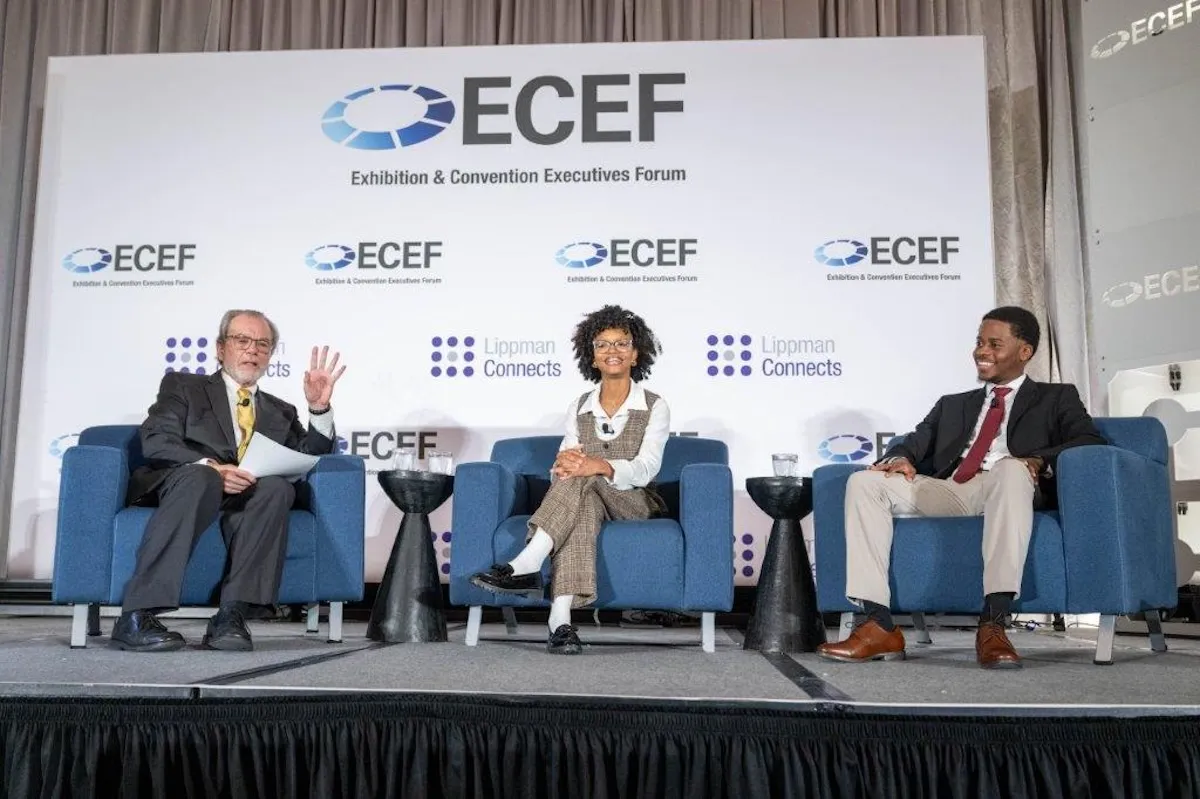
Photo Credit: Sam Lippman, Diamond Vaughn, and Joshua Oloriegbe discuss the Annabelle Project during ECEF. Lippman Connects
Skift Take
The Annabelle Project isn't the events industry's first mentorship program, but it may be the first one paying deliberate attention to who the industry has been overlooking.

The meetings and events industry talks about its talent shortage constantly. What it does less often is trace where that shortage actually comes from.
Warwick Davies, CEO of The Event Mechanic! has a specific answer. "The events industry has an awareness problem," he said. "People don't choose this business because they don't know it exists."
Three years ago, Davies founded The Annabelle Project (TAP), named for his daughter, now nine, as a structured talent accelerator designed to close that awareness gap before students graduate. The program pairs college students with year-long industry mentors, places them at major events, and connects them directly with employers.
TAP isn't trying to solve that problem at scale — not yet. But its placement record is concrete: Graduates have secured positions at Freeman, The Ritz-Carlton Dallas, T3, and the Atlanta Convention & Visitors Bureau.
Who the Program is Targeting and Why
The program focuses on students attending historically Black colleges and universities, and institutions with hospitality programs. "These students aren't lacking ambition or capability," Davies said. "They're lacking proximity to the industry and people willing to open doors."
The program is built around three pillars: mentorship, access, and accountability. The mentorship relationships run a full year. The access component is literal — students attend major industry events and meet senior executives across the meetings and exhibitions ecosystem. The accountability piece is what Davies says separates TAP from more passive pipeline efforts.
"Companies are receiving hundreds of resumes, but many graduates aren't prepared to contribute immediately," he said. "The goal is to make students business-ready."
What Business-Ready Looks Like in Practice
For student Diamond Vaughn, the program's value became tangible at the Exhibition and Convention Executives Forum, where she spoke on a panel and received three job offers.
Her mentor, Sharon Mills, national sales manager at Shepard, introduced her to the industry through experiences including attendance at AfroTech. Vaughn had no prior exposure to events as a professional field.
"This was a new world for me because I never knew events existed as an industry," Vaughn said.
Latisha Clayton, strategic partnerships manager at Vendelux, mentors student Evelyn Lopez. Through the program, Lopez volunteered at Xponential, an engagement that resulted in a job offer. Vendelux is also building a 60-day immersion program for a TAP participant.
"The Annabelle Project gives students experience to help them jump in and start providing business value on day one," Clayton said. "There's no school or college program specifically geared toward the events industry, and TAP really fills that gap."
What Mentors Get Out of It
Sam Lippman, president of Lippman Connects, has been in the industry for nearly four decades. Mentoring student Joshua Oloriegbe, he said, has reconnected him with what drew him to the business in the first place.
"Having the chance to walk the aisles of EXPO! EXPO! with him, seeing our industry through his eyes, and answering his insightful questions has reinvigorated my appreciation of the opportunities live events provide," Lippman said.
Oloriegbe was surprised. "I thought events were something companies did alongside their real work. Then I learned it is a thriving living organism — a whole biome and ecosystem that lives beneath every industry that I care about."
Davies hopes the Annabelle Project becomes less of an exception and more of a model for the industry.
"It doesn't have to be the Annabelle Project," he said. "Something like this should become an industry standard."
At a time when workforce shortages dominate industry conversations, Davies believes the solution may be less about recruiting campaigns and more about personal investment.
"One mentor relationship will do more than 10 panels or a hundred resumes collected at a career fair," he said. "When a student knows someone is personally invested in their growth, the industry stops being abstract and starts being real. That's where retention begins."