Kyle Jordan Uses Innovation to Strengthen Human Connection

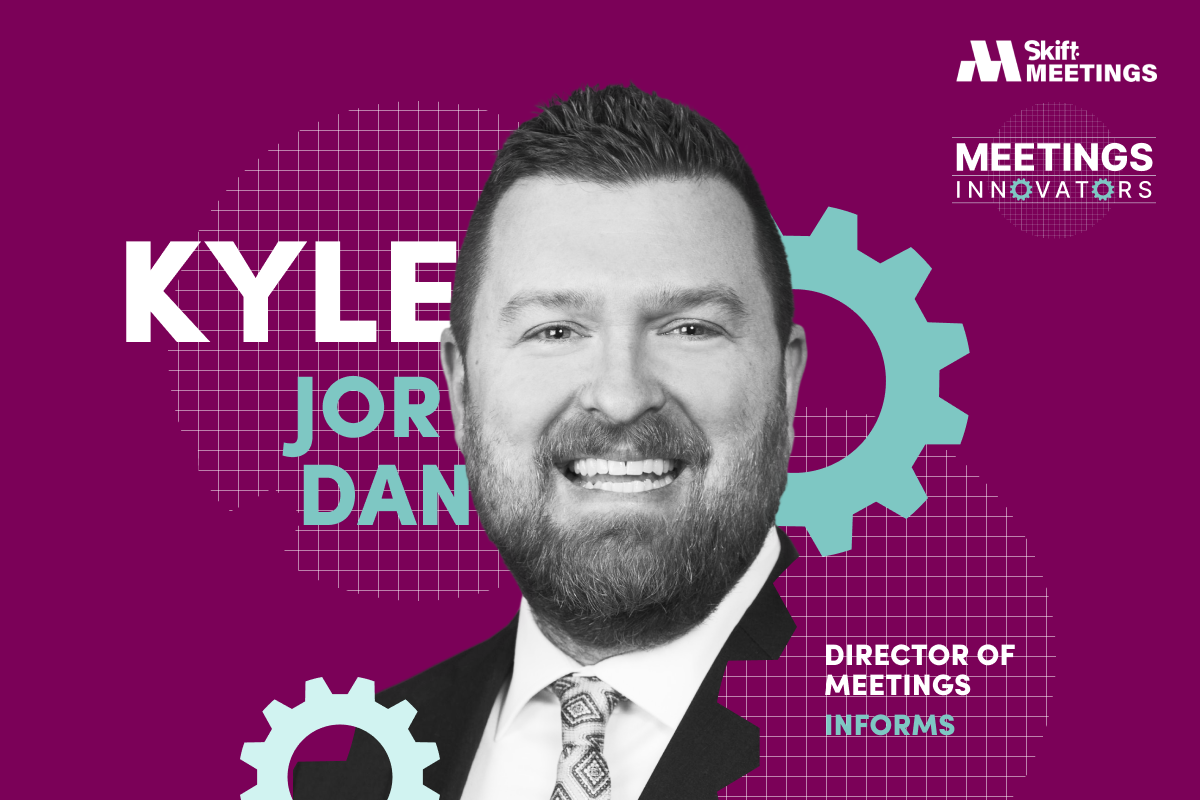
Photo Credit: Kyle Jordan
Skift Take
For Kyle Jordan, innovation isn’t about dazzling attendees with the latest technology. It’s about removing friction to build a stronger sense of belonging and connection.

As director of meetings for The Institute for Operations Research and the Management Sciences (INFORMS), Kyle Jordan is focused on helping every attendee feel seen, welcomed, and connected.
"The future of our industry won’t be defined solely by technology or trends. It will be defined by how effectively we create experiences that feel meaningful," said Jordan.
Education is important to Jordan, who became a Certified Meeting Professional (CMP) in 2015 and was recognized as a CMP Fellow last year. He is also a Certified Association Executive (CAE), Certified in Exhibition Management Advanced Professional (CEM-AP), and a Digital Event Strategist. Jordan has also completed a Certificate of Meeting Management (CMM) from Meetings Professionals International and the Kelly School of Business at Indiana University.
He has held leadership roles at the National Confectioners Association, the Financial Planning Association, and Synergos Association Management Company.
What does innovation mean to you?
To me, innovation is less about being flashy and more about solving real problems in meaningful ways. Sometimes that means adopting new technology, but often it’s about rethinking experiences, processes, or assumptions that no longer serve our members or attendees. The ideas that ultimately matter most are the ones that create stronger connections, provide better access, and help people feel like they belong. I think we sometimes overcomplicate innovation in the meetings industry when, at its core, it’s really about improving how people experience and connect with one another.
Why is innovation important in meetings?
Meetings sit at the intersection of people, knowledge, and experience, and expectations around all three are evolving quickly. If we’re not willing to evolve alongside them, we risk becoming less relevant to the communities we serve. The most effective meetings today are intentional about how people engage, participate, learn, and connect. For better or worse, people remember how they felt at a meeting. The role of innovation should be to strengthen that human experience, not distract from it.
What inspires you to create new approaches to meetings?
A lot of it comes from observing friction points. When I see attendees struggling to connect, navigate, participate, or feel seen in a space, I start asking questions about how we can do better. I’m also inspired by the way different communities gather and create connections. Some of the best ideas don’t come from the meetings industry itself. They come from hospitality, entertainment, education, sports, and other environments where people naturally feel welcomed, engaged, and connected to something larger than themselves.
Is it essential to look for ideas outside the industry?
Absolutely. If the meetings industry only looks at itself for inspiration, we’ll continue recycling the same ideas in slightly different packaging. Some of the most meaningful shifts happening right now are being driven by broader changes in how people communicate, build community, consume information, and experience personalization in their everyday lives. Looking outside the industry helps us better understand those shifts and think more intentionally about how meetings should evolve alongside them.
Is being comfortable with failure part of trying new ideas?
Not every idea works the way you expect, and that has to be part of the process. At the same time, I don’t think failure should be romanticized. The goal is still to be thoughtful, strategic, and intentional in your approach to change. What matters most is creating an environment where teams feel comfortable testing ideas, learning quickly, adjusting, and moving forward. Some of my strongest ideas are the result of refining something that initially missed the mark.
How do you get buy-in for new ideas?
I start by listening. People are much more likely to support change when they understand the purpose behind it and feel included in the conversation. I try to connect new ideas back to our mission, the attendee experience, and the broader goals our members already care about. I also believe strongly in piloting concepts whenever possible. It’s much easier to build confidence around a new approach when people can experience the impact firsthand.
What’s your advice to aspiring innovators?
I’d encourage planners to stay curious and pay close attention to how people experience your meeting and others. You don’t need to be the loudest person in the room or have the most disruptive idea to make a meaningful impact. Some of the best ideas come from noticing what people need. I also think there’s tremendous value in spending less time chasing trends and more time understanding human behavior. Trends will continue to evolve, but people will always want connection and community.
What are you currently working on?
Right now, I’m very interested in how we design meetings that balance scale with community. As our meetings continue to grow, there’s a real risk that our attendees could feel anonymous or disconnected within the experience. I’m exploring ways to use data, AI, and more intentional meeting design to create experiences that feel more personalized, targeted, and meaningful while still preserving the spontaneity and energy that make in-person meetings so valuable.
What professional legacy are you looking to create?
I hope my legacy is helping create a meetings industry where more people feel seen, welcomed, connected, and valued. Of course, I want to be known for strong strategy and meaningful work, but what matters most to me is whether the experiences I helped shape had a lasting impact on people personally and professionally. If the work helped someone find community, opportunity, mentorship, or a sense of belonging, that’s the legacy I care about most.
Any final thoughts?
The meetings industry has always been about bringing people together, but I think the responsibility is even greater now. People are looking for connection, purpose, and community in very real ways, and meetings can create that at an incredibly powerful scale.